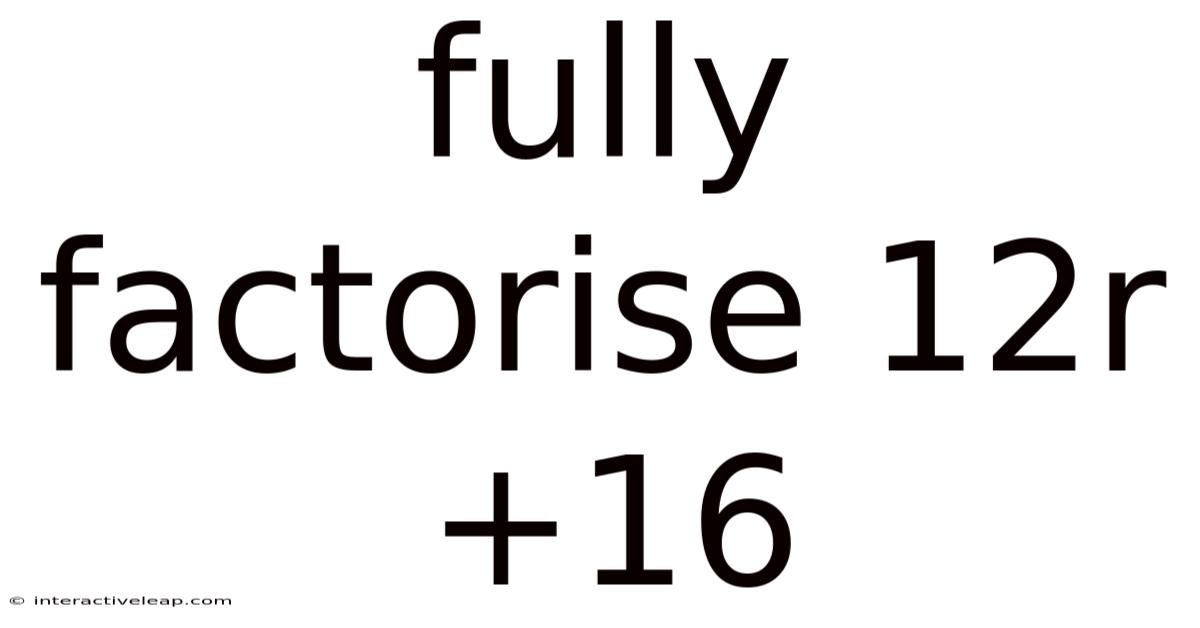
Fully Factorising 12r + 16: A complete walkthrough
Fully factorising algebraic expressions is a fundamental skill in algebra, crucial for simplifying equations and solving problems in various fields like physics, engineering, and finance. This article provides a practical guide to fully factorising the expression 12r + 16, explaining the process step-by-step, exploring the underlying mathematical principles, and addressing frequently asked questions. Understanding this seemingly simple example unlocks the ability to tackle more complex factorization problems.
Understanding Factorisation
Before diving into the specifics of factorising 12r + 16, let's establish a clear understanding of what factorisation actually means. Day to day, factorisation, in essence, is the process of breaking down a mathematical expression into smaller, simpler expressions that, when multiplied together, produce the original expression. But think of it like reverse multiplication. In real terms, just as we can multiply numbers together (e. g., 2 x 3 = 6), factorisation allows us to find the numbers (factors) that, when multiplied, give us the original number (6). The same principle applies to algebraic expressions It's one of those things that adds up. That's the whole idea..
In the context of 12r + 16, we aim to find the factors – numbers and/or variables – that, when multiplied, result in the expression 12r + 16. This process involves identifying common factors among the terms within the expression.
Step-by-Step Factorisation of 12r + 16
The expression 12r + 16 contains two terms: 12r and 16. To factorise this, we need to find the greatest common factor (GCF) of both terms.
-
Identify the factors of each term:
-
12r: The factors of 12 are 1, 2, 3, 4, 6, and 12. The factors of 'r' are just 'r' and 1. Because of this, the factors of 12r are 1, 2, 3, 4, 6, 12, r, 2r, 3r, 4r, 6r, and 12r And that's really what it comes down to..
-
16: The factors of 16 are 1, 2, 4, 8, and 16.
-
-
Find the Greatest Common Factor (GCF): Comparing the factors of 12r and 16, we find that the greatest common factor is 4. Both 12 and 16 are divisible by 4 But it adds up..
-
Factor out the GCF: We now factor out the GCF (4) from both terms:
12r + 16 = 4(3r) + 4(4)
-
Rewrite the expression: Notice that both terms now share a common factor of 4. We can factor this out, resulting in:
12r + 16 = 4(3r + 4)
Because of this, the fully factorised form of 12r + 16 is 4(3r + 4). Worth adding: this means that 4 and (3r + 4) are the factors of the original expression. If you were to expand 4(3r + 4) using the distributive property, you would get back the original expression, 12r + 16 Simple as that..
Mathematical Principles Behind Factorisation
The process of factorisation relies on several fundamental mathematical principles:
-
Distributive Property: The distributive property is the cornerstone of factorisation. It states that a(b + c) = ab + ac. In our example, we essentially applied the distributive property in reverse. We started with ab + ac (12r + 16) and arrived at a(b + c) [4(3r + 4)].
-
Prime Factorisation: Understanding prime factorisation helps identify the GCF more efficiently. Prime factorisation breaks down a number into its prime factors (numbers divisible only by 1 and themselves). As an example, the prime factorisation of 12 is 2 x 2 x 3, and the prime factorisation of 16 is 2 x 2 x 2 x 2. By identifying the common prime factors (two 2s), we quickly find the GCF, which is 4 (2 x 2) But it adds up..
-
Greatest Common Divisor (GCD): The GCF is also known as the greatest common divisor (GCD). The GCD is the largest number that divides both terms without leaving a remainder. Finding the GCD is essential for efficient factorisation No workaround needed..
Expanding on Factorisation Techniques
While the example of 12r + 16 involves simple factorisation using the GCF, more complex expressions may require additional techniques:
-
Difference of Squares: Expressions of the form a² - b² can be factorised as (a + b)(a - b).
-
Quadratic Factorisation: Quadratic expressions (ax² + bx + c) can be factorised using various methods such as factoring by grouping, using the quadratic formula, or completing the square.
-
Grouping: For expressions with more than two terms, grouping similar terms together can help identify common factors and simplify factorisation It's one of those things that adds up..
Practical Applications of Factorisation
Factorisation isn't just a theoretical exercise; it has significant practical applications across various disciplines:
-
Algebraic Simplification: Factorisation simplifies complex algebraic expressions, making them easier to understand and manipulate.
-
Solving Equations: Factorisation is key here in solving polynomial equations. By factorising the equation, you can find the roots (solutions) more easily That alone is useful..
-
Calculus: Factorisation is essential in simplifying expressions in calculus, particularly in differentiation and integration Still holds up..
-
Physics and Engineering: Many physical and engineering problems involve equations that require factorisation for their solution And that's really what it comes down to..
-
Financial Modelling: Factorisation is used in financial modelling to simplify complex formulas and equations related to investments, interest calculations, and risk assessments.
Frequently Asked Questions (FAQ)
Q1: What if there's no common factor between the terms?
A1: If there's no common factor other than 1, the expression is already in its simplest form and cannot be further factorised That alone is useful..
Q2: Can I factorise 12r + 16 in a different way?
A2: While 4(3r + 4) is the fully factorised form, you could technically factor out smaller common factors. Take this: you could factor out 2: 2(6r + 8). That said, this isn't fully factorised because 6r + 8 can still be further factorised by taking out a factor of 2. Always aim for the greatest common factor for complete factorisation Simple, but easy to overlook..
Q3: What happens if I have a negative common factor?
A3: You can certainly factor out a negative common factor. As an example, -4(-3r - 4) is also a valid factorisation of 12r + 16. The choice depends on the context and what form is most convenient for further calculations The details matter here..
Q4: How do I check if my factorisation is correct?
A4: The simplest way is to expand the factorised expression using the distributive property. If you get back the original expression, your factorisation is correct Not complicated — just consistent..
Q5: What are some resources for practicing factorisation?
A5: Many online resources, textbooks, and educational websites offer practice problems and tutorials on factorisation. Focus on understanding the underlying principles and practicing regularly to build proficiency.
Conclusion
Fully factorising 12r + 16 to 4(3r + 4) is a fundamental step in understanding and mastering algebraic manipulation. Worth adding: this seemingly simple exercise demonstrates the power of identifying the greatest common factor and applying the distributive property. The process, while straightforward in this instance, forms the basis for tackling more complex factorisation problems, essential for success in various mathematical and scientific disciplines. By understanding the underlying principles and practicing consistently, you can build a strong foundation in algebra and get to its vast applications in numerous fields. Remember, practice is key to mastering this skill, so keep working through examples and gradually increasing the complexity of the expressions you factorise The details matter here..
