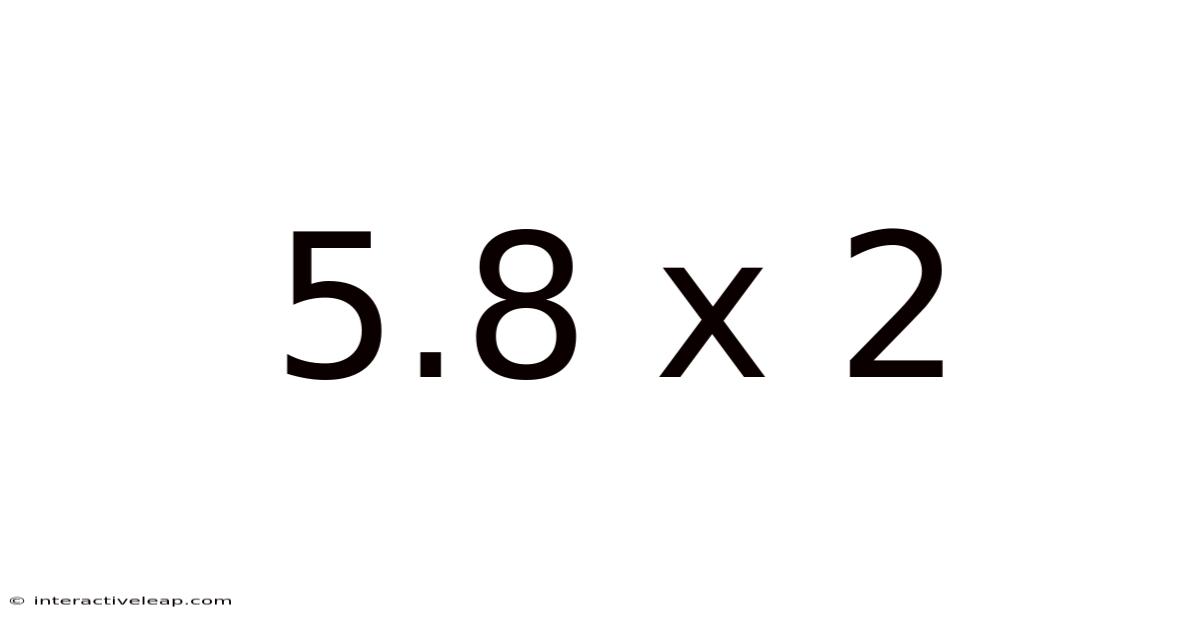
Decoding 5.8 x 2: Exploring Multiplication and its Applications
This article looks at the seemingly simple calculation of 5.In practice, we'll move beyond the basic answer and uncover the broader understanding of multiplication with decimals, its practical uses, and how it forms a foundation for more complex mathematical concepts. On the flip side, 8 x 2, exploring the underlying mathematical principles, different methods for solving it, and its relevance in various real-world applications. This full breakdown is suitable for students, educators, and anyone seeking a deeper understanding of this fundamental arithmetic operation Still holds up..
Understanding the Fundamentals: Multiplication with Decimals
Before tackling 5.8 x 2, let's refresh our understanding of multiplication, particularly when dealing with decimal numbers. Multiplication is essentially repeated addition. Also, for example, 5 x 2 means adding 5 two times (5 + 5 = 10). When we introduce decimals, the process remains the same, but we need to be mindful of the decimal point's position Easy to understand, harder to ignore..
The Decimal Point's Significance: The decimal point separates the whole number part from the fractional part of a number. In 5.8, '5' represents the whole number, and '.8' represents eight-tenths (8/10). When multiplying decimals, the placement of the decimal point in the answer is crucial to obtaining the correct result.
Methods for Calculating 5.8 x 2
Several ways exist — each with its own place.8 x 2, each offering a different approach and level of understanding:
1. Traditional Multiplication: This method involves multiplying the numbers as if they were whole numbers, and then placing the decimal point in the final answer.
- First, ignore the decimal point and multiply 58 by 2: 58 x 2 = 116
- Next, count the number of decimal places in the original numbers (5.8 has one decimal place).
- Finally, place the decimal point in the answer (116) so that it has one decimal place: 11.6
So, 5.8 x 2 = 11.6
2. Distributive Property: This method breaks down the problem into smaller, easier-to-manage parts.
- We can rewrite 5.8 as 5 + 0.8.
- Applying the distributive property, we get: (5 + 0.8) x 2 = (5 x 2) + (0.8 x 2)
- 5 x 2 = 10
- 0.8 x 2 = 1.6
- Adding the results: 10 + 1.6 = 11.6
This method enhances understanding by illustrating how multiplication distributes across addition.
3. Repeated Addition: This is the most basic approach, directly reflecting the definition of multiplication.
- Adding 5.8 two times: 5.8 + 5.8 = 11.6
This method, while straightforward, can become cumbersome for larger numbers or more complex problems. That said, it helps to reinforce the foundational concept of multiplication.
Real-World Applications of 5.8 x 2 and Decimal Multiplication
The seemingly simple calculation of 5.8 x 2 has numerous real-world applications across various fields:
1. Finances and Budgeting: Imagine you purchase two items, each costing $5.80. To calculate the total cost, you'd use 5.8 x 2 = $11.60. This applies to numerous financial scenarios, from calculating grocery bills to determining the total cost of services And that's really what it comes down to..
2. Measurement and Conversions: Decimal multiplication is essential for converting units. As an example, if you have 5.8 liters of a liquid and need to double the quantity, you would use 5.8 x 2 = 11.6 liters. This applies across various units of measurement, including length, weight, and volume.
3. Engineering and Construction: Precision is crucial in engineering and construction. Calculating material quantities often involves decimal numbers. If a design requires 5.8 meters of a specific material and you need twice that amount, the calculation would be 5.8 x 2 = 11.6 meters.
4. Scientific Calculations: Decimal multiplication is prevalent in scientific calculations, such as determining the concentration of a solution or calculating distances in physics. Many scientific measurements involve decimal numbers, making multiplication with decimals a necessary skill That's the whole idea..
5. Everyday Life: Beyond specialized fields, decimal multiplication is essential for various everyday tasks. Take this case: calculating the total cost of goods purchased, determining the total distance traveled, or even splitting a bill equally among friends often requires this skill.
Expanding the Concept: Multiplication with Larger Numbers and Decimals
The principles illustrated with 5.8 x 2 are easily scalable to more complex scenarios involving larger numbers and more decimal places. The core concepts remain consistent:
- Multiply as if they were whole numbers: Ignore the decimal point during the initial multiplication stage.
- Count the decimal places: Add up the total number of decimal places in all numbers being multiplied.
- Place the decimal point: Position the decimal point in the final answer so that it has the same number of decimal places as the total calculated in the previous step.
Here's one way to look at it: let’s consider 12.35 x 3.2:
- 1235 x 32 = 39520
- Total decimal places in 12.35 and 3.2 is 3 (2 + 1).
- Because of this, 12.35 x 3.2 = 39.520 (or 39.52)
Understanding this principle allows you to confidently tackle more complex decimal multiplication problems.
Frequently Asked Questions (FAQ)
Q: What if I forget to add the decimal point after multiplying decimal numbers?
A: Forgetting to account for the decimal point results in an incorrect answer, often by a factor of 10, 100, or 1000 depending on the number of decimal places. Still, the answer will be either too large or too small. Always remember to count the decimal places in the original numbers and accurately position the decimal point in the result Not complicated — just consistent..
Q: Can I use a calculator to solve problems involving decimal multiplication?
A: Yes, calculators are a useful tool for solving decimal multiplication problems, particularly for more complex calculations. Still, understanding the underlying principles is crucial, even when using a calculator, to ensure accurate input and interpretation of the results. Calculators can aid in efficiency, but they shouldn’t replace the understanding of the mathematical process Less friction, more output..
Q: How does decimal multiplication relate to fractions?
A: Decimals and fractions are two different ways to represent the same concept – parts of a whole. As an example, 5.6. 8 can be expressed as 58/10, and then 58/10 x 2 = 116/10 = 11.On the flip side, decimal multiplication is essentially a simplified method of multiplying fractions. This connection reinforces the underlying mathematical coherence That's the part that actually makes a difference..
Honestly, this part trips people up more than it should.
Conclusion: Mastering Decimal Multiplication
The seemingly simple calculation of 5.8 x 2 provides a gateway to understanding broader mathematical concepts related to multiplication with decimals. By mastering this foundational skill, you reach the ability to confidently tackle more complex calculations and apply these principles to a wide range of real-world applications, from everyday budgeting to complex scientific calculations. Which means remember to practice regularly, exploring different methods and applying your knowledge to solve diverse problems. Worth adding: this will solidify your understanding and build a strong mathematical foundation. In practice, the key is not just memorizing the steps, but grasping the underlying principles and their real-world significance. This understanding will serve you well throughout your mathematical journey Worth knowing..
