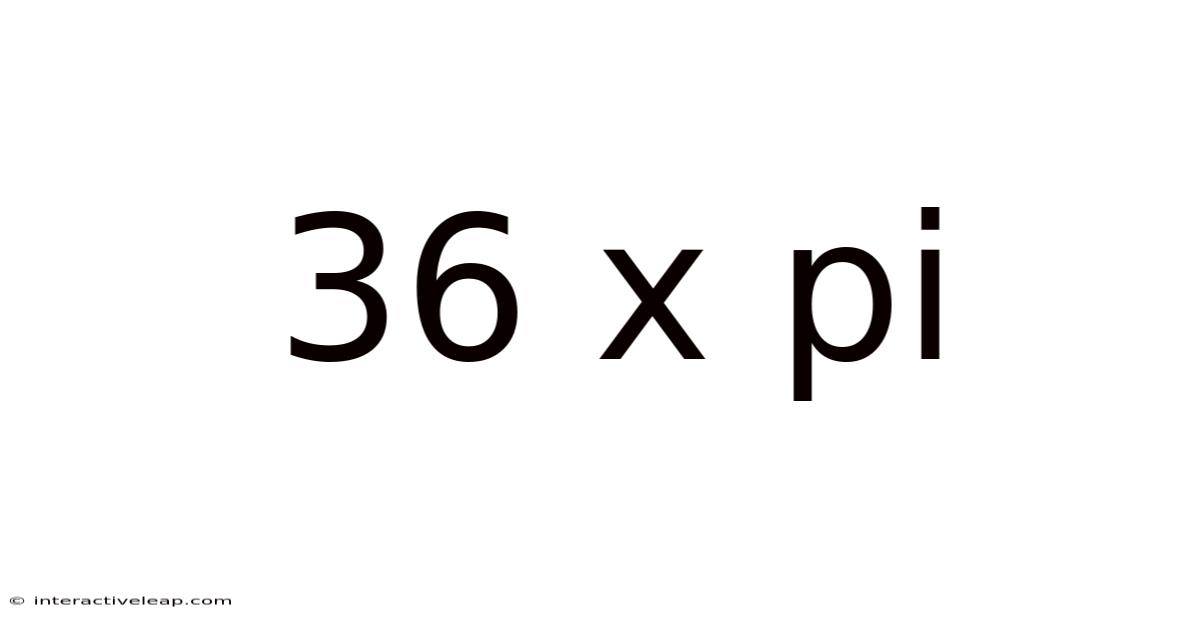
Unveiling the Mystery of 36π: A Deep Dive into the Mathematical Constant
The number π (pi) is a mathematical constant, approximately equal to 3.14159, representing the ratio of a circle's circumference to its diameter. But what about 36π? This leads to this seemingly simple ratio underpins countless calculations in mathematics, science, and engineering. Which means this seemingly arbitrary multiple of π actually holds significant importance in various contexts, ranging from simple geometrical calculations to more complex applications in physics and engineering. Even so, this article will explore the meaning and applications of 36π, demystifying its significance and revealing its practical uses. We will dig into its geometrical interpretations, explore its role in calculating areas and volumes, and discuss its appearance in various scientific formulas.
Understanding the Significance of 36π in Geometry
At its core, 36π represents the circumference of a circle with a radius of 18 units. This stems directly from the fundamental formula for the circumference of a circle: C = 2πr, where 'r' is the radius. Substituting r = 18, we get C = 2π(18) = 36π Worth keeping that in mind..
This simple calculation forms the basis of numerous geometrical problems. Even so, imagine a circular track with a radius of 18 meters. The total distance around the track would be 36π meters. This understanding is crucial in fields like track and field, civil engineering (designing circular roads or structures), and even landscaping That's the part that actually makes a difference..
Beyond Circumference:
While the circumference is the most immediate application, 36π also plays a role in calculating the area of a circle. The area of a circle is given by A = πr². If the radius is 18 units, the area becomes A = π(18)² = 324π square units. Even so, while 36π doesn't directly appear in this area calculation, the relationship between the radius (18) and the circumference (36π) remains intrinsically linked. Understanding this connection is essential for comprehending the proportional relationships within circles But it adds up..
Applications of 36π in Calculating Areas and Volumes
The significance of 36π extends beyond simple circles. It appears in calculations involving more complex shapes derived from circles, such as:
-
Annulus: An annulus is the region between two concentric circles. If the outer circle has a radius of 18 units and the inner circle has a radius of 'x' units, the area of the annulus can be calculated using the formula: A = π(18² - x²). While 36π isn't explicitly present, the outer circle's circumference (36π) provides context for understanding the overall size of the annulus.
-
Cylinders: The lateral surface area of a cylinder is given by A = 2πrh, where 'r' is the radius and 'h' is the height. If the cylinder has a radius of 18 units, its lateral surface area would be 36πh. This formula is frequently used in various engineering applications, including designing pipes, tanks, and other cylindrical structures. Knowing the circumference (36π) helps visualize the lateral surface area more effectively.
-
Spheres: The surface area of a sphere is given by A = 4πr². A sphere with a radius of 18 units has a surface area of 4π(18)² = 1296π square units. Although 36π isn't directly part of this formula, the relationship between radius and circumference remains relevant. Understanding the circumference (36π) provides a scale reference for visualizing the size of the sphere's surface area That's the part that actually makes a difference..
36π in Higher-Level Mathematics and Physics
While the geometrical applications are readily apparent, 36π also makes appearances in more advanced mathematical and physical contexts:
-
Trigonometry: Trigonometric functions, such as sine and cosine, are inherently linked to circles. Calculations involving arcs, sectors, and segments of circles often involve multiples of π. 36π could represent an arc length or a specific angle in a circle with a radius of 18 Simple as that..
-
Calculus: Integration and differentiation, fundamental tools in calculus, often involve π and its multiples. Calculations involving the area under curves or volumes of revolution may involve expressions containing 36π, depending on the specific functions and bounds of integration Worth keeping that in mind..
-
Physics: In physics, particularly in areas like rotational mechanics and wave phenomena, π and its multiples frequently appear in equations describing angular velocity, angular displacement, and wave propagation. The significance of 36π would depend on the specific physical scenario, potentially representing an angular displacement or a component of a physical quantity related to circular motion.
Illustrative Examples: Putting 36π to Work
Let's consider some practical examples illustrating the applications of 36π:
Example 1: Designing a Circular Garden:
Suppose you want to design a circular garden with a radius of 18 feet. You need to know the amount of fencing required to enclose the garden. Using the circumference formula (C = 2πr), the required fencing would be 36π feet. This calculation is essential for purchasing the necessary materials Worth keeping that in mind..
Example 2: Calculating the Volume of a Cylindrical Tank:
A cylindrical water tank has a radius of 18 meters and a height of 10 meters. Now, substituting the values, we get V = π(18)²(10) = 3240π cubic meters. The volume of the tank is given by V = πr²h. While 36π isn't directly part of this calculation, the circumference (36π) provides context for the tank's size and helps in visualizing the volume.
Example 3: Calculating the Area of a Circular Track:
A circular running track has an inner radius of 15 meters and an outer radius of 18 meters. Think about it: the area of the track (the annulus) can be calculated as A = π(18² - 15²) = 153π square meters. The outer circle's circumference (36π) offers a reference point for understanding the overall scale of the track.
Frequently Asked Questions (FAQ)
Q1: What is the approximate numerical value of 36π?
A1: The approximate value of 36π is 36 * 3.In real terms, 14159 ≈ 113. 097 And that's really what it comes down to..
Q2: Are there any real-world applications beyond geometry and physics?
A2: Yes, the concept of 36π, representing a circumference or a portion thereof, can be relevant in fields like computer graphics (creating circular objects), cartography (measuring distances on spherical maps), and even in certain aspects of music theory (representing cyclical patterns) And that's really what it comes down to..
Q3: How does 36π relate to other mathematical constants?
A3: 36π is directly related to the fundamental mathematical constant π. In practice, its value is a simple multiple of π, making it readily calculable and applicable in various mathematical contexts. It doesn't have a direct relationship with other well-known constants like e (Euler's number) or φ (the golden ratio), but its involvement in geometrical calculations connects it indirectly to many other mathematical concepts.
Q4: Can 36π be expressed as a fraction?
A4: No, π is an irrational number, meaning it cannot be expressed as a simple fraction of two integers. So naturally, 36π is also irrational and cannot be expressed as a fraction.
Conclusion: The Enduring Relevance of 36π
36π, while seemingly a simple multiple of a well-known constant, holds significant importance in various fields. Worth adding: its relevance lies not just in its numerical value, but in its ability to provide a practical framework for understanding and calculating circular and related geometrical aspects of our world. From basic geometrical calculations to more complex applications in physics and engineering, understanding its meaning and applications is crucial for solving problems in diverse contexts. This exploration has revealed that 36π is not merely an abstract mathematical concept; it's a practical tool used daily in numerous professions and disciplines. By recognizing its inherent connection to the fundamental constant π and its widespread applications, we can appreciate the enduring relevance of 36π in the world of mathematics and beyond.
