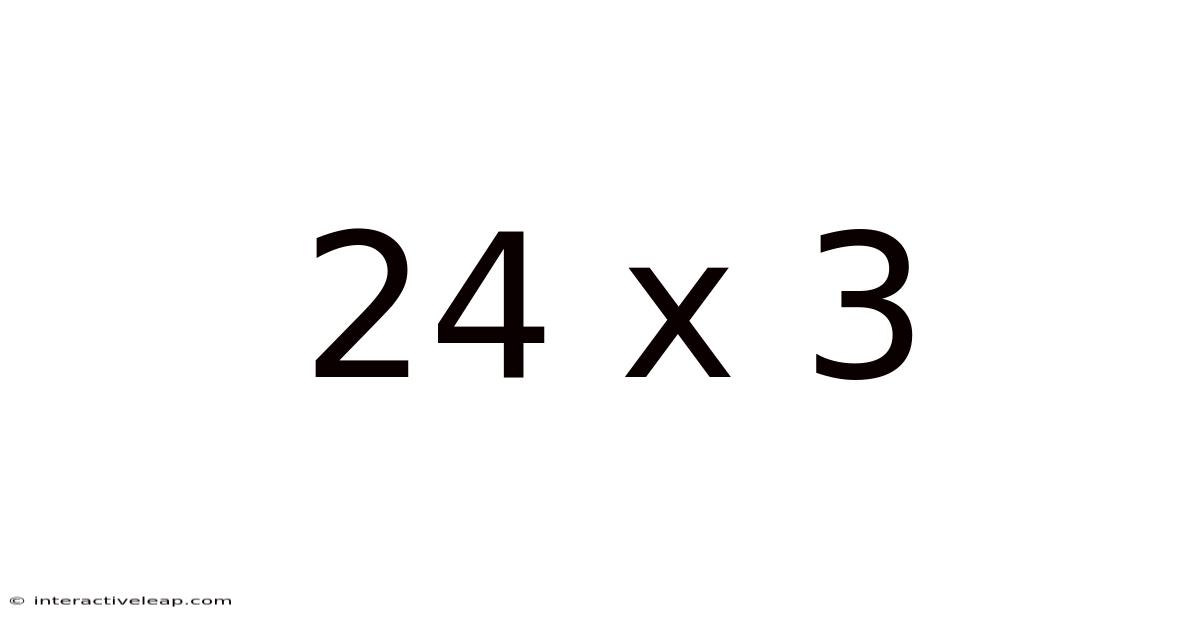
Unveiling the Mystery: A Deep Dive into 24 x 3
This article explores the seemingly simple calculation of 24 multiplied by 3, going far beyond the basic answer. In real terms, understanding this seemingly simple equation can access a deeper appreciation for fundamental arithmetic and its real-world significance. Worth adding: we'll get into various methods of solving this problem, explore its applications in different contexts, and even touch upon the broader mathematical concepts it represents. This thorough look is perfect for students, educators, and anyone curious about the multifaceted nature of mathematics.
I. Introduction: More Than Just a Number
The equation 24 x 3, at first glance, appears trivial. Now, the answer, 72, is easily obtainable with a calculator or basic multiplication knowledge. That said, the true value of this seemingly simple calculation lies in the understanding it fosters regarding fundamental mathematical principles and their practical applications. This exploration goes beyond simply finding the product; it gets into the 'why' behind the calculation, revealing the underlying structure of arithmetic and its relevance to various fields But it adds up..
II. Methods of Calculation: Exploring Different Approaches
There are multiple ways to solve 24 x 3, each offering a unique perspective and reinforcing different mathematical concepts:
A. Traditional Multiplication: This is the most common method, learned in elementary school. We multiply 3 by each digit of 24, starting from the right:
- 3 x 4 = 12. We write down '2' and carry-over '1'.
- 3 x 2 = 6. We add the carry-over '1' to get 7.
- The result is 72.
B. Distributive Property: This method utilizes the distributive property of multiplication over addition. We can break down 24 into smaller, easier-to-manage numbers:
- 24 can be expressed as 20 + 4.
- Applying the distributive property: 3 x (20 + 4) = (3 x 20) + (3 x 4) = 60 + 12 = 72.
This method is particularly useful for mental calculations and highlights the fundamental property governing the interaction between multiplication and addition The details matter here..
C. Repeated Addition: This is a more visual and intuitive approach, especially for beginners:
- 24 + 24 + 24 = 72.
This method directly demonstrates that multiplication is essentially repeated addition. Visualizing the process can be helpful for grasping the concept of multiplication.
D. Using Arrays/Rectangles: This visual representation is excellent for understanding the concept of area and its relationship to multiplication. Imagine a rectangle with a length of 24 units and a width of 3 units. The area of this rectangle represents the product of 24 and 3:
- Area = Length x Width = 24 x 3 = 72 square units.
This method helps visualize multiplication as the calculation of area, offering a geometrical interpretation of the equation.
E. Breaking Down Factors: We can break down the numbers into their prime factors to understand the composition of the product:
- 24 = 2 x 2 x 2 x 3
- 3 = 3
- 24 x 3 = (2 x 2 x 2 x 3) x 3 = 2 x 2 x 2 x 3 x 3 = 72
This approach highlights the prime factorization theorem and shows how the product is composed of the prime factors of its constituents Easy to understand, harder to ignore. But it adds up..
III. Applications of 24 x 3: Real-World Examples
The seemingly simple calculation of 24 x 3 has numerous applications across various fields:
A. Everyday Life:
- Grocery Shopping: Imagine buying 3 packs of cookies, each containing 24 cookies. The total number of cookies would be 24 x 3 = 72.
- Baking: A recipe might call for 24 grams of flour per serving, and you need to make 3 servings. You'll need 24 x 3 = 72 grams of flour.
- Travel: If you drive for 24 kilometers each day for 3 days, you'll have driven a total of 24 x 3 = 72 kilometers.
B. Business and Finance:
- Inventory Management: A company might have 3 warehouses, each storing 24 units of a certain product. The total inventory would be 24 x 3 = 72 units.
- Pricing: If a product costs $24 and you buy 3 of them, the total cost is 24 x 3 = $72.
- Payroll: Calculating the total wages for 3 employees who each earn $24 per hour for a certain period.
C. Science and Engineering:
- Physics: Calculating the total distance traveled by an object moving at a constant speed (24 meters/second) for a duration of 3 seconds.
- Chemistry: Determining the total number of atoms in 3 molecules, each containing 24 atoms.
- Construction: Calculating the total number of bricks needed if each row requires 24 bricks, and you have 3 rows.
IV. Beyond the Basics: Exploring Mathematical Concepts
The equation 24 x 3 provides a gateway to exploring several crucial mathematical concepts:
A. Commutative Property: The commutative property of multiplication states that the order of the numbers does not affect the result. So, 24 x 3 is equal to 3 x 24, both equaling 72. This property simplifies calculations and enhances our understanding of multiplication's fundamental structure Turns out it matters..
B. Associative Property: The associative property allows us to group numbers differently without changing the result when performing multiple multiplications. To give you an idea, if we had (24 x 3) x 2, it's the same as 24 x (3 x 2). This property is essential for more complex calculations That's the part that actually makes a difference..
C. The Concept of Factors and Multiples: 24 is a multiple of 3, and 3 is a factor of 24. Understanding these concepts is vital for simplifying fractions, solving equations, and comprehending number relationships. 72 is a multiple of both 24 and 3 Surprisingly effective..
D. Number Theory: Exploring the prime factorization of 24 (2 x 2 x 2 x 3) and its relationship to the prime factorization of 72 (2 x 2 x 2 x 3 x 3) helps build a foundation in number theory, providing insights into the structure of numbers and their interrelationships.
V. Frequently Asked Questions (FAQ)
Q1: What are some alternative ways to calculate 24 x 3 mentally?
A1: Several techniques can help with mental calculation. One is to round 24 to 25 (which is easily multiplied by 3 to get 75) and then subtract the extra 3 (75 - 3 = 72). Another approach is to break down 24 into 20 + 4, then multiply each part by 3 and add the results (60 + 12 = 72) Worth keeping that in mind..
And yeah — that's actually more nuanced than it sounds.
Q2: Why is understanding multiplication important?
A2: Multiplication is a fundamental operation that forms the basis of numerous mathematical concepts and real-world applications. It's essential for solving problems involving proportions, ratios, scaling, area calculations, and much more. A strong grasp of multiplication is crucial for success in various academic fields and everyday life And it works..
Some disagree here. Fair enough And that's really what it comes down to..
Q3: How does this simple calculation relate to more advanced mathematical concepts?
A3: The seemingly simple 24 x 3 equation underpins more advanced concepts like algebra (solving for unknowns), calculus (rates of change), and linear algebra (matrices and vectors). Understanding fundamental arithmetic is essential for building a strong mathematical foundation.
Q4: Are there any games or activities to help learn multiplication?
A4: Yes, many games and activities can make learning multiplication fun and engaging. These include multiplication flash cards, board games incorporating multiplication, online interactive games, and real-world problem-solving activities.
VI. Conclusion: The Enduring Importance of Fundamentals
The seemingly simple equation, 24 x 3, serves as a microcosm of the beauty and power of mathematics. Worth adding: while the answer, 72, is easily obtained, the journey to arrive at that answer and the exploration of the concepts involved reveal the depth and breadth of mathematical principles. Practically speaking, by understanding various calculation methods, recognizing its applications in different contexts, and appreciating the underlying mathematical concepts, we gain a deeper appreciation for the fundamental importance of arithmetic in both academic and practical life. Which means this exploration highlights that even the most basic mathematical operations can hold significant value when examined critically and comprehensively. The seemingly simple act of multiplying 24 by 3 becomes a gateway to a richer understanding of the mathematical world.
